





149,246
Slip and Fall Injuries in Wisconsin
Unintentional falls led to 149,246 emergency room visits in Wisconsin in 2025, including 27,561 by Milwaukee County residents.

Slip and fall accidents are more than just embarrassing, they can be devastating. Many victims suffer broken bones, head injuries, spinal trauma, or chronic pain. And when these accidents happen due to someone else’s negligence, you shouldn’t be left to deal with the consequences alone.
Tell us about your case. A real attorney will respond within 1 business hour.
Every review below is a real Google review from a real client. Click through to verify.
It's been great working with Toby. He's an excellent attorney that helped immensely during this difficult and stressful period. I especially appreciate open honest dialogue which he always provides.
Great experience overall! Very communicative & informed me about everything every step of the way!
I was in a life-threatening car accident in April of 2023 caused by a drunk driver. I was given Toby Mulholland's information through my insurance agent, and contacting him was the BEST decision I could have possibly made. Let me just say, Toby was my advocate every step of the way - in the midst of such a traumatic accident, I had comfort knowing my Lawyer was doing everything in his power to right the wrongs of the person who nearly took my life. Everything about that experience was new to me - I had never been in an accident, dealt with insurance, filed a suit, given a deposition, etc. Toby was informative regarding all the legal processes which were taking place, and answered all questions I had - in essence: he was my biggest advocate other than myself. He is extremely organized, well spoken, and knows exactly what he is talking about. Without his help, I don't know how I would have gotten through such a turbulent time. If you find yourself in a similar position to me, where it feels like your world is collapsing, medical facilities trying to push you around, insurance companies calling you... Toby Mulholland is the person you need to shield you from the noise, the advocate you deserve, and the best Lawyer around. Thank you for everything you have done to help me in my most dire of times, Toby!
Thank You for being more than attorney and seeing My situation for more than a payout if You're looking for a Lawyer that's gonna use the law to get You what You deserve and not be bought out by big corporations make sure You give Toby a call
I have been dealing with this law firm & Mr. Toby for a while now & have brought some friends to them, everyone left satisfied, and the relationship became more than just a client but a friendship, he works with passion, explains all the steps to you & guides you to the best, five stars ⭐️
Very responsible and caring team. I recommend Mulholland law to anyone in search of a great attorney. Toby was great! he is so down to earth and easy to reach. He clarified any doubt I had and explained the whole process step by step. Thank you so much for all you've done for me and my family. I am forever grateful!
Your Trusted Injury Lawyer

Since launching his law practice in 2000, Toby P. Mulholland has been a dedicated advocate for clients suffering serious injuries. He has extensive experience handling a wide range of personal injury cases, including motor vehicle accidents, wrongful death claims, construction accidents, premises liability, dog bite cases, and catastrophic injury litigation.
Toby’s distinguished career is marked by his skill in litigation, participating in numerous trials, mediations, arbitrations, and depositions. His innovative approaches to depositions have consistently resulted in successful outcomes for even the most complex cases. Clients appreciate his ability to navigate high-stakes situations with a creative, results-oriented approach.
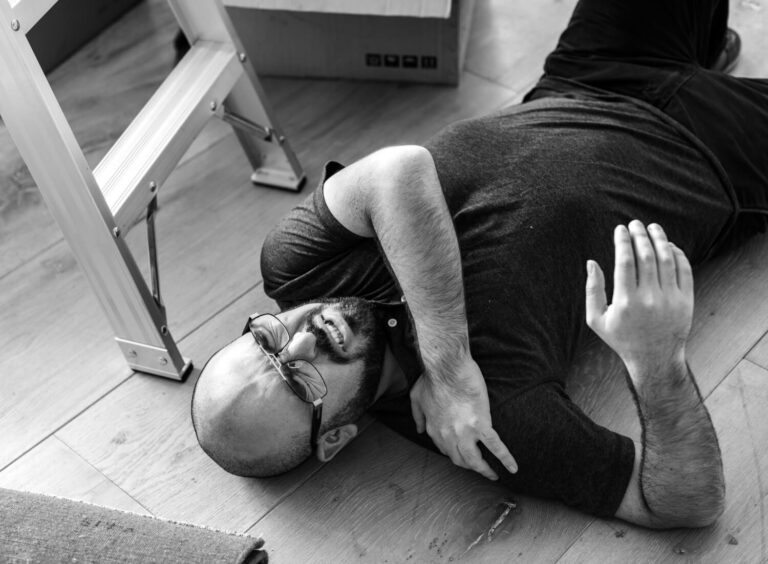
Falls may seem minor, but they often result in lasting pain, missed work, or permanent disability.
Our firm represents Milwaukee residents who were hurt in all types of slip, trip, and fall accidents, including:
Spills, recently mopped surfaces, or leaks left unattended without warning signs.
Cracked sidewalks, broken tiles, or warped floorboards can pose a serious tripping hazard.
Inadequate lighting in stairwells, parking lots, or hallways makes it hard to see obstacles.
Unsecured floor coverings that slide or bunch up can easily cause someone to fall.
Boxes, wires, and debris left in walking paths can obstruct safe movement.
Property owners may be liable if they fail to remove snow and ice in a timely manner.
Broken or unstable staircases and missing handrails can contribute to serious falls.
Certain environments require specific types of shoes; failure to warn or enforce proper footwear can increase risk.
No matter how the injury occurred, if a property owner failed to keep their space reasonably safe, you may be entitled to financial compensation for your injuries.
Falls are a leading cause of injury in Wisconsin, and Milwaukee is no exception. These figures come from Wisconsin hospital data, the CDC and the U.S. Bureau of Labor Statistics.
149,246
Unintentional falls led to 149,246 emergency room visits in Wisconsin in 2025, including 27,561 by Milwaukee County residents.
75%
Adults aged 65+ account for more than 60% of all fall-related hospitalizations in Milwaukee County. In 2025, they made up 1,929 of the county’s 2,574 nonfatal fall hospitalizations, about 75%.
48,308
Unintentional falls killed 48,308 people in the U.S. in 2024, and more than 14 million older adults, about 1 in 4, report falling every year.
23%
Falls, slips, and trips made up 23% of private-sector work injuries requiring days away from work in Wisconsin in 2021 and 2022, or 9,120 of 39,580 cases.
Wisconsin also has the highest death rate from falls among adults 65 and older of any state: 158.4 per 100,000 in 2023, more than twice the national rate of 69.9. CDC NCHS Data Brief 532
Businesses, landlords, and homeowners must correct known hazards or warn visitors about them.
Under Wisconsin premises liability laws, property owners have a responsibility to keep walkways, stairwells, and entryways safe. That means fixing issues like ice buildup, loose tiles, water leaks, and uneven floors in a timely manner.
Unfortunately, many property owners fail to take those precautions. A lack of signage, poor lighting, or careless maintenance can quickly turn a routine visit into an emergency room trip.
Wisconsin holds property owners to one of two standards, depending on the kind of property where you fell. Knowing which one applies shapes the whole claim.
| Homes, duplexes and other private property | Stores, workplaces and public buildings | |
|---|---|---|
| Which law | Ordinary negligence law | The safe place statute, Wis. Stat. § 101.11 |
| The owner’s duty | Ordinary care toward anyone on the property with the owner’s consent. Wisconsin dropped the old “invitee” and “licensee” labels in 1975. | Keep the premises as safe as their nature reasonably permits, a higher duty than ordinary care. |
| What it covers | Single-family homes and duplexes. Wisconsin courts have held that a duplex is not a “public building.” | Places of employment and buildings used by the public or by 3 or more tenants, including porches and entry steps. In apartment buildings, it reaches the common areas, not the inside of a tenant’s unit. |
| Proving notice | You generally need to show the owner knew or should have known about the hazard. | A structural defect, meaning a flaw in how something was built or designed, does not require notice. A hazard from poor repair or upkeep requires proof the owner knew or should have known. |
| Your own fault | Under both standards, your share of fault reduces what you recover, and you can recover only if your fault is not greater than the owner’s. | |
Wis. Stat. § 101.11 § 101.01(12) “public building” Megal, 2004 WI 98 Barry, 2001 WI 101 Wis JI-Civil 8020 § 895.045
Milwaukee averages 48.7 inches of snow a year, most of it from December through February. Who answers for an icy fall depends on where it happened.
The City of Milwaukee requires owners and occupants to clear the sidewalk next to their property within 24 hours after snow stops falling. You can report an unshoveled walk at (414) 286-CITY.
Even so, Wisconsin treats a public sidewalk as the city’s responsibility, and a claim against a city or county over a natural build-up of snow or ice is barred unless it had been there for 3 weeks. Ice formed by an artificial condition is treated differently.
Wis. Stat. § 893.83 League of Wisconsin Municipalities City rule, via FOX6Businesses and landlords of buildings with 3 or more units fall under the safe place statute. Snow or ice that was left too long, or meltwater tracked inside without mats or warning signs, can support a claim when the owner knew or should have known about it.
Wisconsin health officials counted 33,597 workers’ compensation claims for falls on ice or snow during the colder months from 2000 to 2022. Public administration and transportation and warehousing workers had the highest claim rates.
Wisconsin DHS, P-03571Multiple parties may be at fault, including business operators, landlords, maintenance crews, or even municipalities.
Determining liability in slip and fall claims often requires a detailed investigation. While many victims assume only the property owner is responsible, others may also share blame.
Potentially liable parties include:
Our legal team will examine the scene, request surveillance footage, interview witnesses, and review inspection records to hold the right parties accountable.
Claims against a city, county or other local government follow special rules in Wisconsin, and missing one can end a claim before it starts.
Wisconsin generally requires a signed notice describing the circumstances of the fall within 120 days, followed by an itemized claim stating a specific dollar amount. You can sue only after the claim is denied, or after 120 days pass without a decision.
Wis. Stat. § 893.80Damages against a local government are generally capped at $50,000 per person, and punitive damages are not allowed. Falls during recreation, such as hiking or sightseeing in a park, can also be barred by Wisconsin’s recreational immunity law.
§ 893.80(3) § 895.52Falls often result in serious and long-lasting injuries that affect your daily life and ability to work.
Slip and fall injuries vary in severity, but they often have one thing in common: they’re painful, disruptive, and expensive. We routinely see cases involving:
State laws allow victims to recover damages when negligence leads to unsafe conditions.
Wisconsin allows injured individuals to pursue compensation when a fall was caused by a property owner’s failure to maintain reasonably safe premises. Under the state’s comparative negligence law, you can still recover damages even if you were partially at fault, as long as you weren’t more than 50% responsible.
Additionally, if your fall occurred at work, you may be entitled to workers’ compensation benefits. But if a third party’s negligence contributed to the accident, such as a property manager or maintenance vendor, you may also be able to file a personal injury claim for pain and suffering and other non-economic losses.
0 to 50% You can recover, reduced by your percentage of fault.
51% or more No recovery from that party.
Your fault is compared separately with each party you claim against. Wis. Stat. § 895.045
From proving negligence to dealing with insurers, we take care of it all so you can focus on healing.
At Mulholland Injury Law, our team handles every part of your case:
We gather photo evidence, incident reports, and witness statements to establish liability.
We work with your doctors to clearly document injuries and calculate future care needs.
We communicate directly with insurers to fight for a fair settlement.
If a settlement can’t be reached, we’re ready to take your case to court.
Slip and fall cases are often undervalued by insurance companies. We make sure you’re taken seriously and fairly compensated.
Property owners and insurers often dispute fault or downplay injuries to avoid liability.
Slip and fall claims can be tricky, especially when the property owner claims they didn’t know about the hazard or that you were at fault. Common issues include:
We counter these tactics with solid evidence, expert opinions, and aggressive advocacy so you get what you’re owed.
Taking the right steps can protect your health, and your legal rights.
We’re committed to standing up for victims of negligence, and we know how to win.
Our Milwaukee slip and fall lawyers have helped numerous victims recover meaningful compensation after preventable accidents. We’ve taken on major retailers, landlords, and insurers, and we never settle for less than what our clients deserve.
You have three years from the date of the accident to file a personal injury lawsuit. If the fall occurred on government property, shorter notice deadlines may apply. For the City of Milwaukee or Milwaukee County, a written notice of claim is generally due within 120 days of the fall.
Yes. Wisconsin’s comparative negligence rule allows compensation if you’re 50% or less at fault, though your award is reduced by your percentage of fault. Your share of fault is compared separately with each party you are claiming against.
Property owners often repair hazards after accidents. This doesn’t eliminate liability, and in some cases, it helps prove the condition was dangerous and known. Wisconsin’s evidence rules generally bar using a later repair to prove ordinary negligence, but the repair can be used to prove a safe place statute violation, or to show who owned or controlled the property.
Yes. Insurance companies often downplay these cases. An attorney ensures your claim is taken seriously, all damages are accounted for, and your rights are protected.
It depends on your injuries, medical costs, lost wages, and how the fall has affected your life. We evaluate every aspect to pursue full compensation.
Milwaukee requires owners and occupants to clear the sidewalk next to their property within 24 hours after snow stops, but Wisconsin treats public sidewalk upkeep as the city’s duty. A claim against the city for a natural build-up of snow or ice is generally barred unless it existed for 3 weeks. Ice on a store’s entrance, a parking lot or an apartment building’s walkway is a different question, and the owner may be responsible.
Send a signed written notice describing the fall within 120 days: to the City Clerk, Attn: Claims, 200 E. Wells St., Room 205, for city property, or to the Milwaukee County Clerk, Courthouse Room 105, 901 N. 9th St., for county property. An itemized claim with a specific dollar amount must follow, and damages against a local government are generally capped at $50,000 per person.
If the building has 3 or more units, it is generally a “public building” under the statute, and the owner must keep the common areas, such as hallways, stairs and entrances, as safe as their nature reasonably permits. Wisconsin courts have held that a duplex is not covered, so falls there are judged under ordinary negligence law.
It can be difficult. Wisconsin’s recreational immunity law generally protects landowners, including local governments, from claims by people injured during recreational activities such as hiking or sightseeing. There are narrow exceptions, such as a malicious failure to warn about a known hazard, so these cases need a close look at the facts.
Tell your employer within 30 days. Workers’ compensation generally covers medical care and part of your lost wages, but you usually cannot sue your own employer. If someone else caused the hazard, such as a property owner, snow removal contractor or cleaning company, you may also have a personal injury claim against them.
If you slipped and fell in Milwaukee due to unsafe conditions, you may be facing not just physical pain, but also steep medical bills, time off work, and emotional distress.
At Mulholland Injury Law, we fight for injured victims across Milwaukee who were hurt because a property owner failed to maintain safe conditions.
Whether your fall happened in a grocery store, parking lot, apartment complex, or workplace, we’ll help you understand your legal options and pursue full compensation.
At Mulholland Injury Law, we are committed to providing aggressive legal representation for victims of personal injury accidents.
Summarized from the Wisconsin Statutes, Wisconsin court decisions, the City of Milwaukee, Milwaukee County, the Wisconsin Department of Health Services, the CDC, the U.S. Bureau of Labor Statistics and the National Weather Service as of October 2026. This is general information, not legal advice. Deadlines, damage caps and immunities have exceptions, so talk to a lawyer about your situation.